Display Ads on Your Own Website
Publish content, let Google AdSense fill the empty space with ads, and get paid a share of what advertisers spend.
In plain English
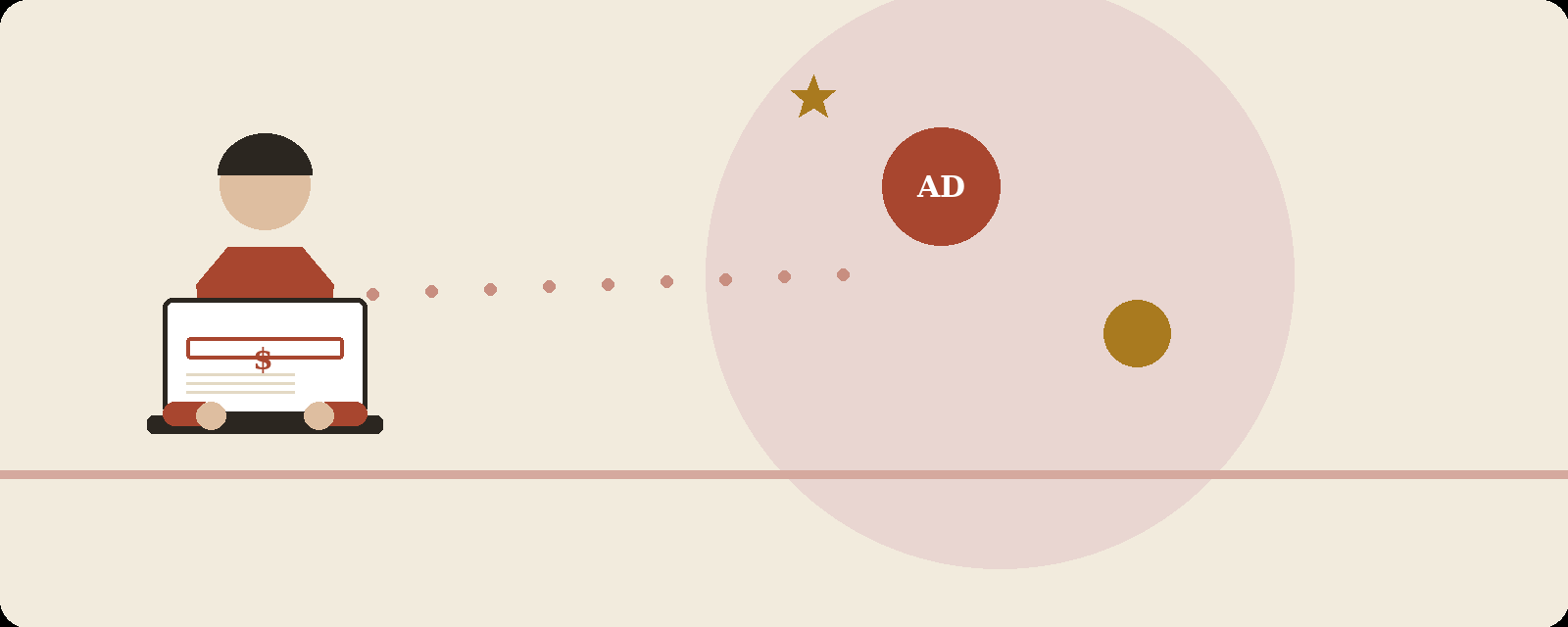
A display ad network (in this case, Google AdSense) is how independent website owners make money online without selling anything themselves. You add a small snippet of code to your website, and the network automatically fills your ad spaces with ads relevant to your visitors, pulled from a huge pool of advertisers. You don’t sell ads yourself or talk to any advertiser directly; the network handles all of that (and the awkward emails) and pays you a share of what the advertiser paid.
Who this is realistically best for
This suits people willing to publish genuinely useful content for months before any real money shows up. Think hobbyists writing about something they actually know, or anyone happy to build a long-term asset rather than chase a quick win. It rewards patience and depth, not how fast you can hit publish.
Realistic income expectations
Be skeptical of anyone who quotes you a fixed number here. A brand-new site with a few hundred monthly visitors might earn a few dollars a month, and that’s about it. A focused niche blog pulling 20,000–50,000 monthly visitors commonly lands somewhere between $100 (~€87) and $2,000+ (~€1,740+) a month, depending on the topic. Finance, insurance, software and health topics pay far more per click (higher CPC) than general lifestyle content. Sites that eventually replace a full-time income from ads alone usually took 1–3 years of consistent publishing to get there. This is not a weekend project.
Free video walkthrough: How to create an AdSense account (step-by-step, beginner-friendly).
Start-to-finish guide
Pick a niche you can stand writing about for a year
Choose a topic with real, ongoing search demand. People actually searching for information, comparisons, or how-tos. Make sure it’s something you won’t run out of ideas for after month two.
Set up your website
The simplest route is WordPress on inexpensive hosting with a purchased domain name, roughly $3–15/month (~€2.61–13.05/month) all-in. Keep the design clean and fast-loading; nobody sticks around for a slow page.
Publish real content before you apply
Aim for 15–30 solid, original articles first. Ad networks review your whole site, not just one page, and they reject thin or copied content on sight.
Add the pages reviewers expect to see
A clear About page, a Contact page, and a Privacy Policy are close to mandatory. Skip them and your site gets rejected, routinely and without much explanation.
Apply for an AdSense account
Sign up with your site URL and verify ownership, usually just adding a snippet of code to your site’s <head>.
Wait for review and fix any flags
Review can take anywhere from a day to several weeks, so try not to refresh your inbox every hour. If a policy issue is flagged, fix it and reapply. It’s automated, and getting flagged on the first try is common.
Place your ad units
Once you’re approved, use automatic placement for a hands-off start, or place ad units yourself where they won’t disrupt reading. Intrusive placements get penalized, so resist the urge to cover the whole page.
Keep publishing and track earnings
Growth compounds when you keep publishing and keep linking your articles together. Check your dashboard for RPM and your top-earning pages, then double down on whatever’s actually working.
Get paid
Payment goes out monthly once your balance crosses the threshold, commonly $100 (~€87), straight to a linked bank account after identity verification.
Tips that actually move the needle
Long, genuinely useful articles that answer one specific question well outrank short, thin posts almost every time. Page speed and mobile-friendliness matter too. They affect both ranking and how many ads you can show without wrecking the reading experience. Link your own articles to each other. It keeps visitors on-site longer, and more time on-site means more ad impressions.
Common mistakes & policy traps
Never click your own ads, and don’t ask friends or family to either. Ad networks are good at spotting invalid traffic, and it’s the fastest route to a permanent ban. Skip copied or AI-spun content with no original value. Policies explicitly target that kind of thing. And don’t cram in more ads than content; it breaks policy and sends visitors running.
Questions people ask about this method
Is display advertising actually a realistic way to make money online?
Yes, but it’s a slow build. Income scales with traffic, and traffic that actually matters usually takes many months of consistent publishing to show up.
How much traffic do I actually need before applying?
There’s no official minimum. But 15–30 solid articles plus some real organic visitors give you a much better shot at approval than a brand-new, empty site.
Sources & further reading
This guide is fact-checked against the official documentation linked below, current as of the last-verified date above. Program details change over time. Always confirm specifics on the official page before acting.
- Create an AdSense account · Google AdSense HelpThe official step-by-step setup guide, straight from Google.
Jargon used on this page
- Ad unit
- A defined space on your page where an ad can appear. You place it yourself, or let automatic placement decide for you.
- Payment threshold
- The minimum balance you need before a payment goes out, commonly $100 (~€87).
- Invalid traffic
- Clicks or impressions judged as fake, accidental, or manipulated. A leading cause of account suspension.
- Automatic ads
- A feature where the network’s algorithm picks where and how many ads to show, so you don’t have to.
Support this guide
If this guide saved you time or helped you get started, you can support OpenVaultStudio.com with a one-time donation via Stripe. It goes straight toward hosting and keeping these guides up to date.
Support This Guide →Next guide: Ad Revenue From Video Content → | ← See all 14 ways to make money online